
Walter Isaacson (September 2023)
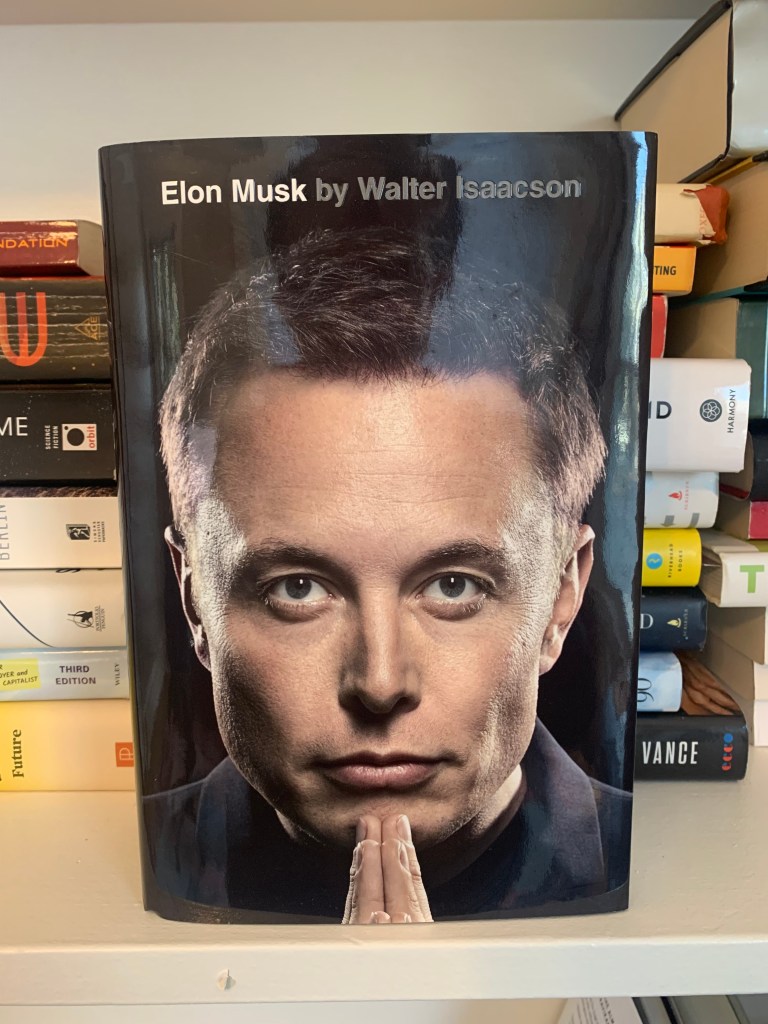
I thought this was an excellent book, hence why I feel compelled to publish my thoughts. My first Isaacson. Very readable and the semi-chronological order is the correct way to write this type of book as it strikes the balance between following connected threads (i.e., life events) without overdoing it by having sections narrowly dedicated to SpaceX, Tesla, Twitter, etc. It’s especially impactful for this particular object – Elon has a million different projects going on at once and it would be dilutive to categorize and drive through without addressing the other 12 projects happening in tandem (not to mention his personal life).
Methodology for reviewing this book
- Notes. I underlined, wrote in the margins, and on sticky notes. Scattered throughout the book. I’ll address each one and why I believe it was important.
- Key Takeaways. Important themes that arose numerous times.
- I don’t want to go chapter-by-chapter, mostly because they’re each ~5 pages long and about 100 chapters in total.
My key highlights / themes from the book:
- Hardcore
- A maniacal sense of urgency is our operating principle
- Control
- As a manager
- Of the value chain
- SolarCity acquisition to complement the battery. “We really wanted to have an integrated product, but it was difficult when the engineers were at two different companies.” (254).
It makes total sense, but it doesn’t seem like the Solar business is that important to Tesla atm.
- SolarCity acquisition to complement the battery. “We really wanted to have an integrated product, but it was difficult when the engineers were at two different companies.” (254).
- When most clients are given three or four options, they will ask which one the banker recommends. Musk, instead, asked detailed questions about each option but did not solicit a recommendation. He likes to make his own decisions. (490). Thinking for yourself. Getting all the data possible so that you can make a decision.
- Deep affection for humanity at a macro-level but indifference towards humans at a micro-level. Treating humans as tools to accomplish the mission.
- “By trying to be nice to the people,” Musk says, “ you’re actually not being nice to the dozens of other people who are doing their jobs well and will get hurt if I don’t fix the problem spots.” (273)
- The amount of human intelligence was leveling off, because people were not having enough children. – I don’t necessarily agree with this. Actually maybe I do. I think the comparison between intelligence and population is overly simple/lazy, although you can’t deny. Correlation does not imply causation. 604
- This is how civilizations decline. They quit taking risks. And when they quit taking risks, their arteries harden. Every year there are more referees and fewer doers. That’s what America could no longer build things like high-speed rail or rockets that go to the moon. When you’ve had success for too long, you lose the desire to take risks. 609
- Design <> Engineering
- Musk put the engineers and designers in the same room. “The vision was that we would create designers who thought like and engineers and engineers who thought like designers.” (200)
- This follows the principle that Steve Jobs and Jony Ive had instilled at Apple: design is not just about aesthetics; true industrial design must connect the looks of a product to its engineering. ” In most people’s vocabularies, design means veneer,” Jobs once explained. “Nothing could be further from the meaning of design. Design is the fundamental soul of a man-made creation that ends up expressing itself in successive outer layers.” (200)
- By sending their factories abroad, American companies saved labor costs, but they lost the daily feel for ways to improve their products.
Musk bucked this trend, largely because he wanted to have tight control of the manufacturing process. He believed that designing the factory to build a car – “the machine that builds the machine” – was as important as designing the car itself. Tesla’s design-manufacturing feedback loop gave it a competitive advantage, allowing it to innovate on a daily basis. (218) - OCD is one of the reasons for their [Jobs and Musk] success, because they obsessed on solving a problem until they did. What set them apart is that Musk, unlike Jobs, applied that obsession not just to the design of a product, but also the underlying science, engineering, and manufacturing. Steve just had to get the conception and the software right, but the manufacturing was outsourced. Jobs loved to walk through Apple’s design studio on a daily basis, but he never visited his factories in China. Musk, in contrast, spent more time walking assembly lines than he did walking around the design studio. “The brain strain of designing the car is tiny compared to the brain strain of designing the factory”, Musk says. (218)
- Von Holzhausen and his deputy, Dave Morris, who accompanied him to Fremont, would sometimes walk the factory’s assembly lines until two in the morning. It was an interesting experience for a designer. “It taught me how all the things you create on the drawing board have an effect at the other end, on the assembly line” Holzhausen says. Musk joined them two or three nights a week. His focus was on root causes. What in the design was to blame for a production-line problem? (220)
- Jesus-level stuff. That’s the sort of problems Elon works on. “We can give people crazy vision. Want to see infrared? Ultraviolet? How about radio waves or radar?” Information and communication theory! Underpins everything …
- We don’t want to design to eliminate every risk, otherwise we will never get anywhere. 611
- Questioning “the system”
- Deleting things
- “If you don’t have to add back at least 10% of what you deleted, then you didn’t delete enough.”
- This seems like an insanely burdensome task. Necessary, but painful. Being hypersensitive to friction, and then questioning its origin.
- Skip-Level meetings. Skipping the level of who you normally meet with so that you get a more realistic view of the operation than a filtered manager narrative. Speaks to the importance of managers having a realistic view of what their subordinates are doing. Always be willing to get your hands dirty and to do the work you manage. The higher you get the more important this becomes.
- DE-automation
- Musk’s production algorithm: always wait until the end of designing a process – after you have questioned all the requirements and deleted unnecessary parts – before you introduce automation (274).
- I really appreciate his willingness to admit he was wrong here. It was a controversial move to make everything automated from the outset. Being able to objectively look at its impact and accept that it’s not the most efficient way of doing things / remembering what you’re optimizing for – number of cars. Anything that enables that number to increase is fair game (all is fair in love and war).
- Perfect World Backcasting – The Tent
- Again, understanding the goal: manufacture more cars. Although, this is a slippery slope – early on, outsourcing to China is the key to accomplishing the goal, so at what point does something become off the table? Everything is relational and understanding consequences, weighing pros/cons.
It has to be so tiring to constantly be questioning things like he does. I feel like whenever I question a process, there’s a decent answer for why it exists and I will capitulate or compromise around it being there. I probably need a better framework. CONSTANTLY THINK OF THE GOAL. Instead of doing the calculations in my head that leads me to compromise, my canned response should be “so how does this impact our goal of X?”.
- Again, understanding the goal: manufacture more cars. Although, this is a slippery slope – early on, outsourcing to China is the key to accomplishing the goal, so at what point does something become off the table? Everything is relational and understanding consequences, weighing pros/cons.
- Deleting things
- Arbitrage.
- Idiot index
- Do it for cheaper
- An interesting life.
- He meets millions (?) of people throughout the course of the year, many of whom are very interesting. I’m jealous of that! How exciting of a life to lead! (189)
- Working for Musk is hard. There’s a fine line between being a pushover ‘yes man’ vs speaking your mind (199). How do you challenge him when he creates an impossible deadline? Knowing that he delivers outcomes beforehand may give you the assurance that it’s possible…
- It seems like it’s physically impossible for him to be as up to speed as he needs to be when he’s required to attend meetings and make important strategic decisions. He seems to pivot quite a bit from what everyone else was planning. Sometimes sending them on wild goose chases.
- How many cybertruck owners have no clue who Elon Musk is? I feel like it’s too much of his brain child and not a standalone legitimate vehicle someone in the market for a new truck would consider. Model 3/Y, perhaps moreso.
- I do appreciate that the Cybertruck makes “the future look like the future.”
- “If they see the general out on the battlefield, the troops are going to be motivated. Wherever Napoleon was, that’s where his armies would do best. Even if I don’t do anything but show up, they’ll look at me and say that at least I wasn’t spending all night partying.” 481
- If he wanted the survivors at Twitter to be hardcore, he was going to have to show them how hardcore he could be. He slept on the floor of his first office at Zip2 in 1995. He had slept on the roof of Tesla’s Nevada battery factory in 2017. He had slept under his desk at the Fremont assembly plant in 2018. It wasn’t because it was truly necessary. He did it because it was in his nature to love the drama, the urgency, and the sense that he was a wartime general who could rally his troops into battle mode. Now it was time for him to sleep at Twitter headquarters. 447
- I don’t like or agree with his nepotism. I think people who only surround themselves with family have severe trust problems. You only spend time with those who are biologically required to care for you, not those who chose to do so out of their own volition.
- Musk had moved on from demon mode … and he never mentioned the advertising boycott again or followed up on his orders. Henry Kissinger once quoted an aide saying that the Watergate scandal happened “because some damn fool went into the Oval Office and did what Nixon told him to do.” 539 LOLLL
- Musk had wrought one of the greatest shifts in corporate culture ever. Twitter had gone from being among the most nurturing workplaces, replete with yoga studios to the other extreme. He did it not only for cost reasons. He preferred a scrappy, hard-driven environment where rabid warriors felt psychological danger rather than comfort. 557
- Moving the Twitter servers: James went on Yelp and found a company named Extra Care Movers that would do the work at one-tenth the cost. The motley company pushed the ideal of scrappiness to its outer limits. – Understanding the problem, the constraints, and what options are on the table! 588
- Enclosed hardware.
- Philanthropy.
- Turning down Bill Gates due to, among other reasons, his belief of higher humanity ROI via investing time/resources into his companies than to give a handout. 439
- Painted BG in a horrible light. I took the short position and kept it on for a while because “I thought I could make some money.” INSANE. Terribly hypocritical too – why would he put his money on the demise of the most important climate company?
- Sort of effective altruistic like SBF. I think he’s 100% right though.
- “He felt that the good he could do for humanity…” He thinks about philanthropy at too much of a macro-level. He wants to help humanity, not humans.
- Turning down Bill Gates due to, among other reasons, his belief of higher humanity ROI via investing time/resources into his companies than to give a handout. 439
- The Commandments (likely touched upon elsewhere) 284
- Question every requirement. Get the person who made it a requirement on the phone. Requirements from smart people are the most dangerous because people are less likely to question them.
- Delete any part, or process, that you can. If you don’t have to add back at least 10% of what you deleted, then you didn’t delete enough.
- Simplify and optimize. This should come AFTER step 2 (the prior step). A common mistake is to simplify and optimize a part or process that should not exist.
- Accelerate cycle time. Only do this after completing the prior 3 steps. Don’t accelerate processes that should have been deleted in the first place.
- Automate. This comes last. Wait until all the requirements have been questioned, parts and processes deleted, and the bugs get shaken out before automating.
- The Sub-Commandments
- All technical managers must have hands-on experience. Managers of software teams must spend at least 20% of their time coding, or else they are like the cavalry leader who can’t ride a horse or a general who can’t wield a sword.
- Skip level meetings to get to real problems.
- When hiring, look for people with the right attitude. Skills can be taught, but changes in attitude requires a brain transplant.
- A maniacal sense of urgency is our operating principle.
- Twitter was a bad idea.
- He never let go of his desire to turn X/PayPal into a social finance company. 455
- The business model of the internet is advertising. Having an entirely user financed (entertainment/social) platform doesn’t seem possible. You can’t charge people to get into the park, to sit on the grass, bring their own blanket, etc. It’s a strange disassociation with money. It becomes a little play thing, which is really bad. Gamifying your bank account.
- We want to have one place where people with different viewpoints can interact
- This is great in theory, but it’s too large of a market for unique opinions/ideas to live. People want to find their cult and they will gravitate towards their desired bucket and reject others.
- You start out by finding a niche market. You can’t start too large, or else you become nothing for everyone vs. everything for some. The former is the work of governments, not private companies.
- It’s an interesting way to pursue a social problem. Most would probably take a government route (legislation, policy, non-profit, etc.). Opting for enterprise is interesting and a very Elon move. I totally agree with the principle that this is how more problems should be solved.
- “I don’t think from a cognitive standpoint it’s nearly as hard as SpaceX or Tesla.” – It’s a moving target.
- Sustaining humanity via democracy – Totally fair, but it’s a super long horizon and thankless job though.
- He truly didn’t seem to still be interested in buying Twitter. Was actively trying to poison the deal, but dug himself in too far.
- Community Notes are a great addition. It’s a step in the right direction and gives me hope that he could actually get it right with these sorts of features.
- Kimbal: “I really don’t give a shit about Twitter. It’s just a pimple on the ass of what should be your impact on the world.” 587
- He never let go of his desire to turn X/PayPal into a social finance company. 455
- Random Items.
- Starlink is fascinating. I wonder how obvious of a decision it was to pursue. If you’re building rockets, you need a payload that governments (or other payers) are looking to send into space. There’s only a handful of payload items over the past 20 years.
- Polytopia 426
Be proactive. “I’m a little bit of a Canadian pacifist and reactive,” Zilis says. “My gameplay was a hundred percent reactive to what everyone else was doing as opposed to thinking through my best strategy.” She realized that, like many women, this mirrored the way she behaved at work. Both Musk and Mark Juncosa told her that she could never win unless she took charge of setting the strategy.
Double Down. “Elon plays the game by always pushing the edge of what’s possible,” Zilis says. “And he’s always doubling down and putting everything back in the game to grow and grow. And it’s just like he’s done his whole life.” – There’s a risk aversion element that causes many people to fear doubling down. When there’s so much momentum behind a thing, you start to second guess decisions you would have easily made before the thing was a behemoth. Your priority shifts from growth to maintenance.
Other themes:
- Risk. I feel like there should be a second bucket for themes that I don’t care about pondering.
…
 BVC
BVC 